Hunan Huacheng Biotech, INC · INDUSTRY INSIGHT
Expanded acreage, steady production, and rising raw material prices set the stage for this year’s monk fruit harvest. This overview examines the development of natural monk fruit resources, regulatory standards for synthetic biology, how these two production approaches differ, and future opportunities in the advanced processing of monk fruit extract.
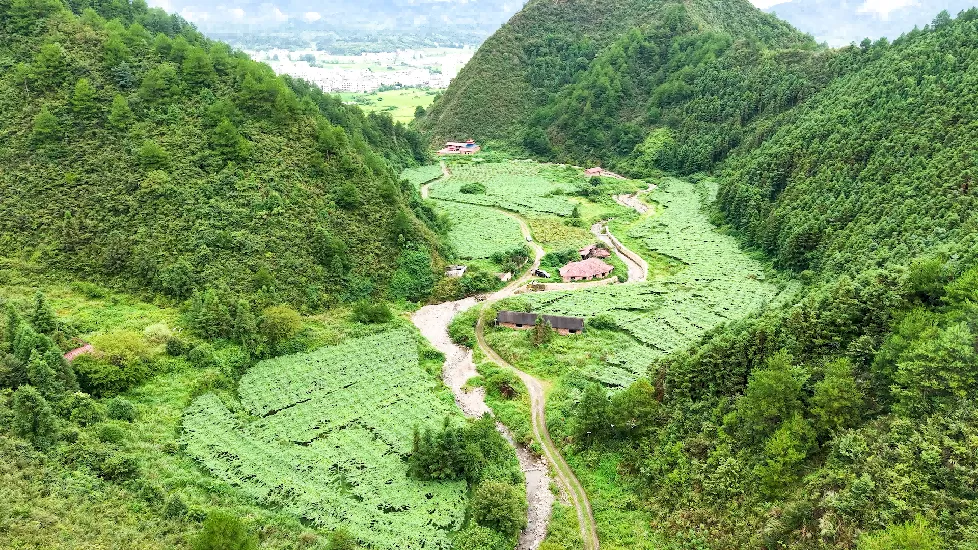
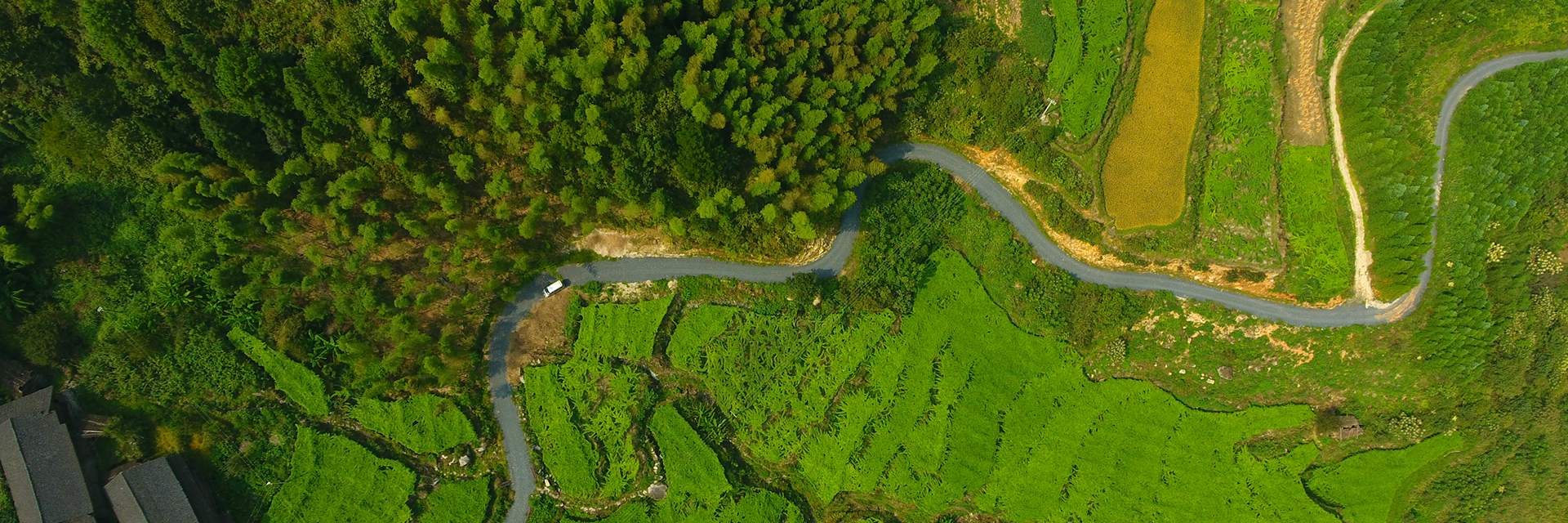
Monk Fruit Raw-Material Production Regions
The 2026 monk fruit harvest is drawing to a close following another year of geographic expansion. National planted acreage increased by approximately 30% compared with 2025. Acreage doubled in Hunan and Guizhou, while Guilin, the traditional production hub, recorded more modest growth. Cultivation now spans seven to eight provinces, including Guangxi, Hunan, Guizhou, Yunnan, Fujian, and Hainan. Liuzhou, Hunan, and Guizhou have grown particularly quickly and together account for approximately half of total production, with considerable room for further expansion.
Despite the increase in acreage, successive weather challenges pushed the harvest below expectations. Above-average rainfall during the seedling stage damaged root systems and contributed to widespread disease, with particularly sharp yield declines in Yongfu, a traditional production center, and areas farther south. Drought during flowering added further pressure. Together, these conditions reduced fresh-fruit quality compared with last year, with active ingredient levels generally lower.
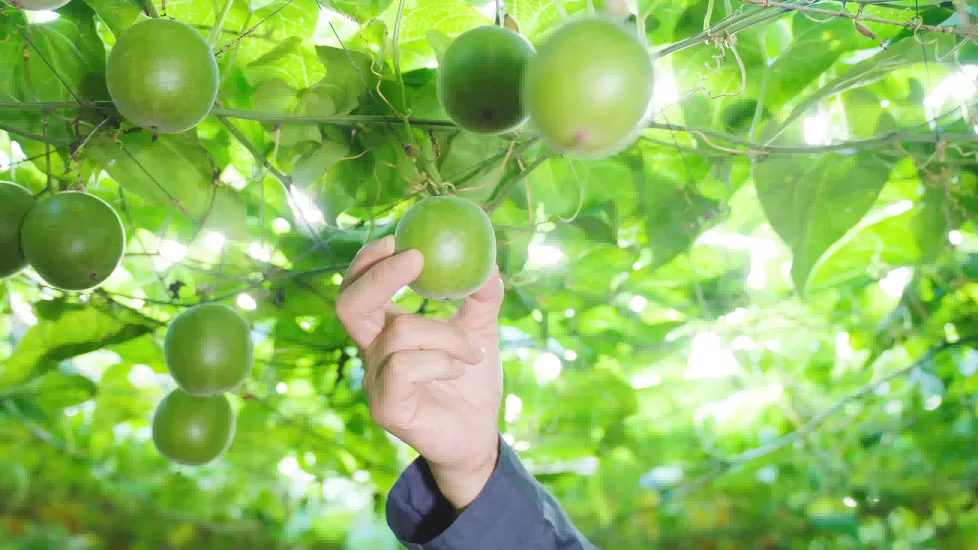
Fresh Monk Fruit of the 2026 Harvest Season
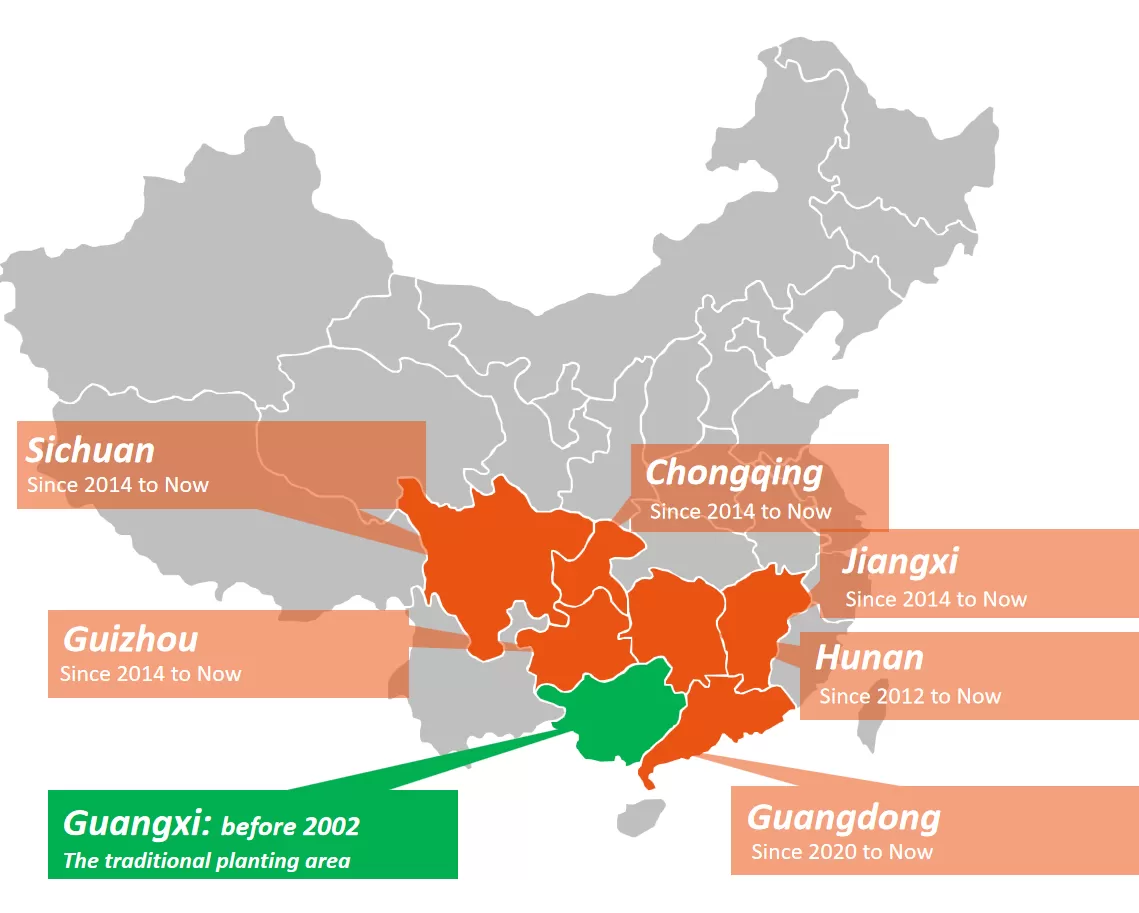
The monk fruit industry originated in Guilin, Guangxi, where its early growth centered on dried-fruit production. Before 2002, cultivation was concentrated in Longjiang Township, Yongfu County, and a handful of neighboring townships. Planted acreage totaled less than 5,000 mu, with annual fresh-fruit production below 3,000 tons.
To expand cultivation beyond these traditional growing areas and increase supply, Hunan Huacheng Biotech, Inc. began trial planting in Hunan Province in 2012. From 2014, the company extended cultivation into Jiangxi, Guizhou, and other provinces. In 2020, it began promoting cultivation in Yingde, Longmen, and other parts of Guangdong.
After more than a decade of development, Huacheng has established monk fruit cultivation across a broad geographic footprint.
| Planted Area and Output by Region, 2002–2026 | |||||||||
|---|---|---|---|---|---|---|---|---|---|
| Region / Area (mu) | 2002 | 2012 | 2018 | 2021 | 2022 | 2023 | 2024 | 2025 | 2026 |
| Guangxi: Guilin | 5000 | 10000 | 30000 | 45000 | 50000 | 150000 | 70000 | 80000 | 90000 |
| Guangxi: Liuzhou & Hezhou | 10000 | 30000 | 32000 | 100000 | 30000 | 40000 | 50000 | ||
| Hunan | - | 500 | 5000 | 20000 | 45000 | 60000 | 20000 | 25000 | 30000 |
| Guizhou | - | - | 500 | 4000 | 25000 | 50000 | 20000 | 30000 | 35000 |
| Jiangxi | - | 500 | 1000 | 10000 | 30000 | 5000 | 8000 | 10000 | |
| Guangdong | - | - | 200 | 500 | 1000 | 5000 | 500 | 1000 | 2000 |
| Yunnan | - | - | 500 | 1000 | 2000 | 5000 | 500 | 1000 | 2000 |
| Sichuan & Chongqing | - | - | - | - | - | - | 1000 | 2000 | |
| Total: | 5000 | 10500 | 46700 | 101500 | 165000 | 400000 | 146000 | 186000 | 221000 |
| Avg. annual fresh-fruit output (tons): | 3000 | 6300 | 28020 | 60900 | 99000 | 252000 | 87600 | 111600 | 110500 |
| V50-equivalent annual output (tons): | 24 | 48 | 215 | 468 | 761 | 1800 | 673 | 858 | 850 |
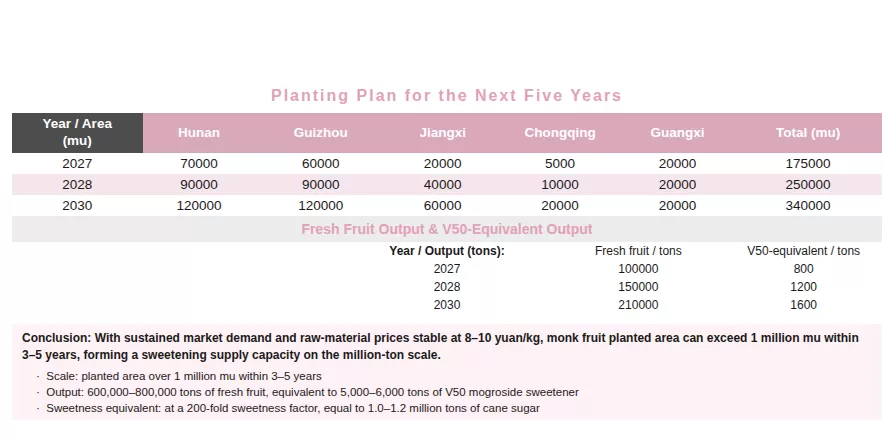
At the peak of the 2026 growing season, monk fruit acreage exceeded 60,000 mu in Hunan and 30,000 mu in Jiangxi, while reaching 40,000 mu in Guizhou. Combined acreage outside Guangxi has already surpassed that of the Guilin production region. With sustained market demand, cultivation outside Guangxi is expected to eventually exceed the province’s total planted acreage.
Monk fruit cultivation brings farmers, cooperatives, and enterprises together in a model that supports the industry’s sustainable growth. It creates employment opportunities for older adults and vulnerable groups in rural communities, returns idle farmland to productive use, and increases farmers’ earnings, with average net income of 5,000–6,000 yuan per mu. By strengthening rural livelihoods, this approach advances rural revitalization while bringing the natural, healthy sweetness of monk fruit to consumers.
Following recent announcements of research breakthroughs and laboratory trials involving Mogrosides produced through synthetic biology, Hunan Huacheng Biotech, Inc. offers the following assessment based on its industry experience.
In Huacheng’s assessment, these technologies remain at the laboratory and bench-scale stages. Production costs, purity, by-product control, and process scale-up require further development before consistent commercial production and reliable supply can be established.
Natural monk fruit production depends on agricultural cultivation and supports farmers, cooperatives, and productive land use. Its contribution to rural employment, farmer income, and rural revitalization is an integral part of the industry’s value. Synthetic biology follows a separate production pathway with a different economic and social footprint.
Even if synthetic biology enables commercial-scale production, the resulting sweeteners will require assessment based on their production methods, composition, and intended uses. Regulatory classification, permitted ingredient names, and labeling requirements will depend on the product and the destination market.
Huacheng believes that clear distinctions in sourcing and labeling will remain essential. Natural monk fruit extract carries agricultural origins, a connection to farming communities, and consumer expectations associated with fruit-derived ingredients. These attributes will continue to shape its position in the market as alternative production technologies develop.
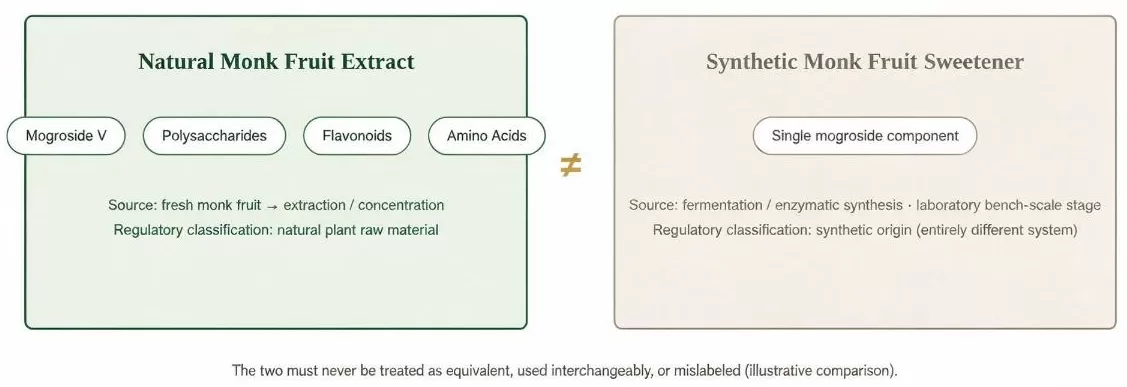
Figure 2 | Natural vs. synthetic: two entirely different raw materials (illustrative comparison)
| Comparison Dimension | Natural Monk Fruit Extract | Synthetic Mogrosides |
|---|---|---|
| Sourcing Path | Fresh monk fruit → extraction / concentration | Fermentation / enzymatic synthesis |
| Composition Profile | Complex composition: mogroside V, polysaccharides, flavonoids, amino acids, etc. | Single mogroside component |
| Regulation & Labeling | Classified and declared as a natural plant raw material | Classified as synthetic origin, with an entirely different naming system |
| End-Use Value Attributes | Natural, clean label, food-and-medicine homology perception | Cost-driven sweetening solution |
| Industrialization Maturity | Mature mass production, stable supply | Laboratory / bench-scale stage |
Key Note: The two must never be treated as equivalent, substituted for each other, or confused in labeling; otherwise there are serious compliance risks and risks of misleading consumers.
Natural monk fruit has a long history of use as both a food and a traditional medicinal resource. Alongside mogrosides, the fruit contains polysaccharides, flavonoids, amino acids, and other naturally occurring compounds that contribute to its broader botanical composition and flavor profile. Producing an individual sweetening compound captures only part of this complexity.
The value of natural monk fruit also reaches beyond the ingredient itself. Growing regions across multiple provinces support employment and higher incomes for tens of thousands of farmers. This agricultural network connects the industry’s growth with stronger rural livelihoods and tangible progress in rural revitalization.
| Monk Fruit Extract | Monk Fruit Concentrated Juice | Natural Fruit Powder | Functional Food Ingredients |
|---|---|---|---|
| Standardized mogroside content, for beverages and sugar-reduction systems | Retains natural flavor, suited to drinks and seasonings | Whole-fruit utilization, extending into powdered beverages and bakery | Food-and-medicine homology attributes supporting health-product development |

Monk Fruit Extract Series
As synthetic biology creates new production pathways for sweeteners, verifying ingredient origins is becoming increasingly important. Hunan Huacheng Biotech, Inc. remains committed to natural extraction and is collaborating with leading universities and research institutions to develop a fingerprint-based authentication system for distinguishing naturally extracted monk fruit ingredients from those produced through synthetic biology.
The system combines UPLC-MS/MS with compositional fingerprinting and stable-isotope analysis, using methods tailored to different production pathways.
The methods are currently undergoing development and validation, with the aim of establishing an industry-association or broader industry standard. A key objective is to detect low levels of blending between ingredients from different production pathways.
Once validated, the system is intended to make ingredient origins more transparent and verifiable. It would help customers substantiate sourcing and labeling claims, identify potential blending, and manage regulatory compliance while giving consumers greater confidence in the authenticity and traceability of natural monk fruit ingredients.
01. Cultivation can expand to support demand. With planting planned a year in advance, the natural monk fruit industry can increase acreage and production to meet growing market needs.
02. Synthetic biology follows a separate development pathway. Huacheng expects natural botanical extraction to retain its role, supported by its agricultural origins, farming communities, and contribution to rural development.
03. Natural monk fruit offers a distinctive value proposition. Its established use, diverse botanical composition, and consumer familiarity support its market position, alongside continued attention to safety, quality, and regulatory compliance.
04. Further processing and broader applications will drive future growth. As a distinctive botanical resource native to China, monk fruit offers opportunities for advanced processing, diversified applications, and fuller utilization of its components over the coming decade.

Botanical Extraction Line
Hunan Huacheng Biotech, Inc. maintains a long-term commitment to the entire natural monk fruit supply chain. Using naturally grown fruit, the company produces standardized, high-purity monk fruit ingredients under rigorous safety and quality controls. It maintains clear separation between natural extraction and synthetic production systems, providing customers worldwide with compliant, traceable natural ingredients and a reliable supply.







 EN
 EN
 CN
 ES
 PT
 SV
 DE
 TR
 FR
 AR
 BG
 HR
 CS
 DA
 NL
 FI
 EL
 HI
 IT
 JA
 KO
 NO
 PL
 RO
 RU
 CA
 TL
 IW
 ID
 LV
 LT
 SR
 SK
 SL
 UK
 VI
 SQ
 ET
 GL
 HU
 MT
 TH
 FA
 AF
 MS
 GA
 BE
 UZ